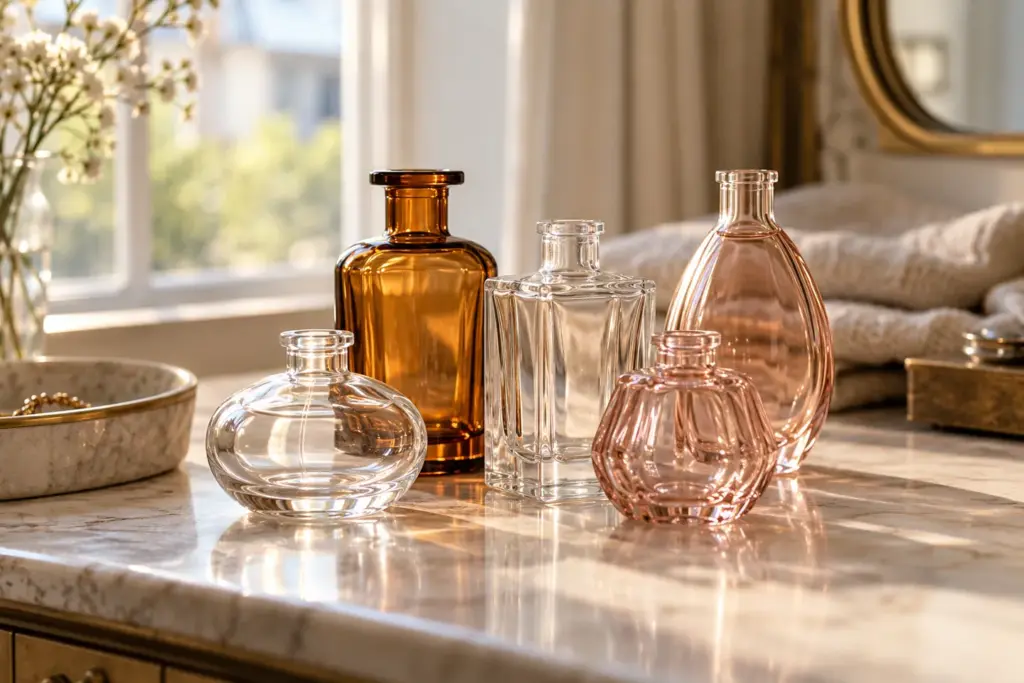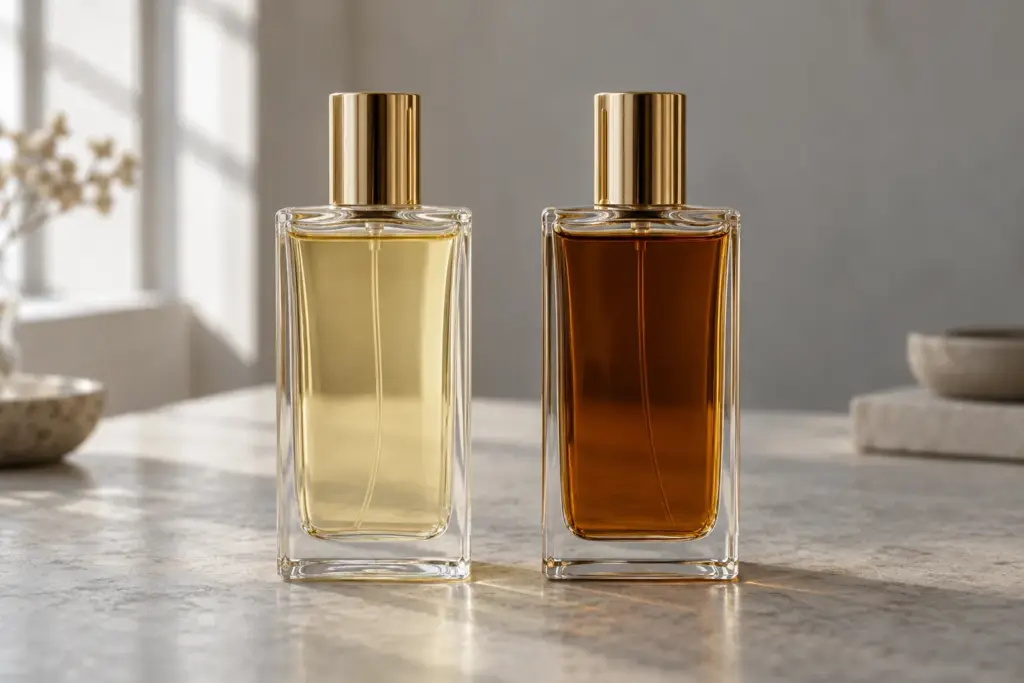
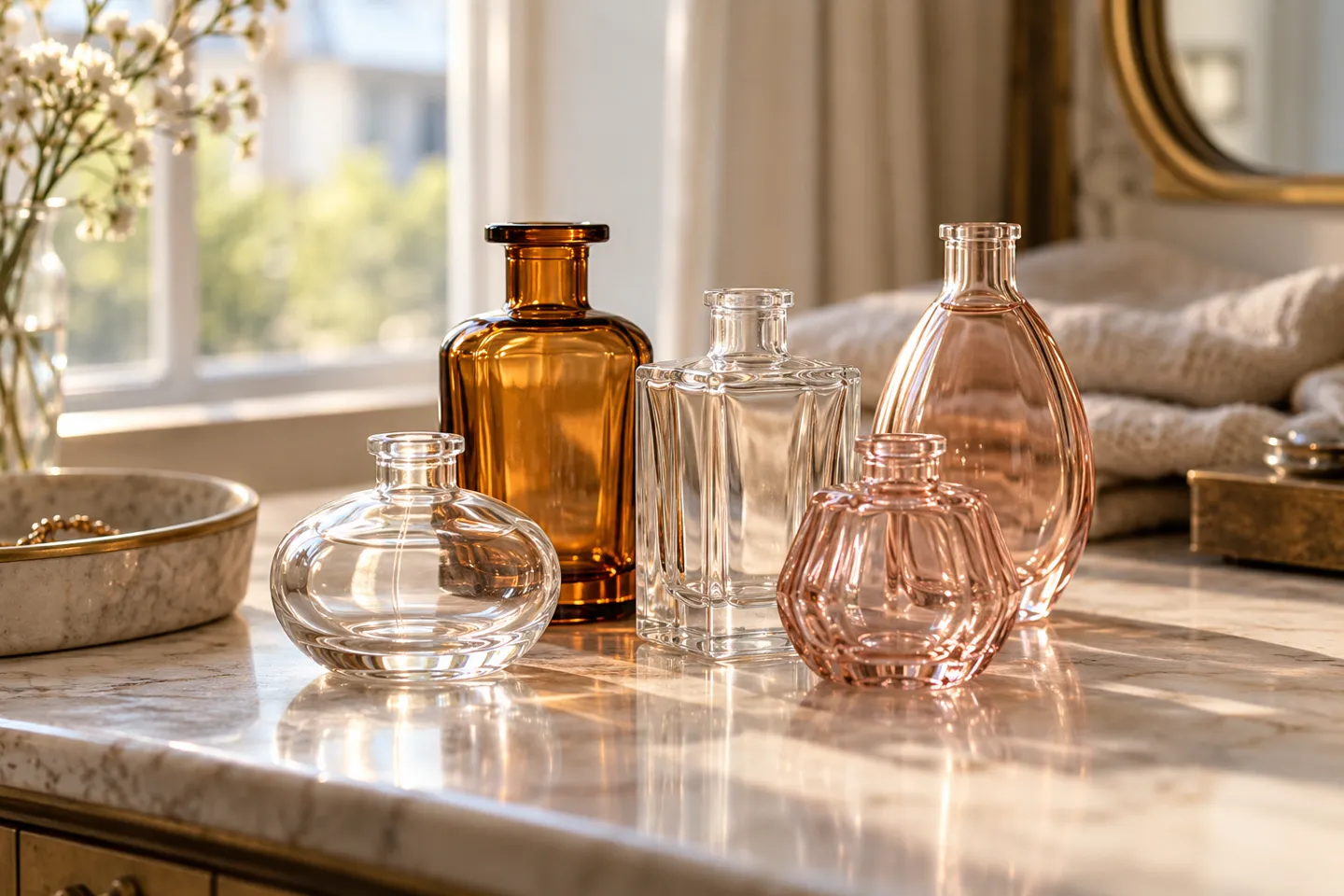
Two founders can pin the same silhouette to a mood board and still end up five weeks and one mold fee apart. The shape of a perfume bottle looks like a style call. In practice it sets your minimum order, your lead time, your filling line, and the markets where the design actually sells. Style is the visible half of the decision; the other half is what the silhouette does to your cost sheet.
The Shape Families: A Working Vocabulary
Most glass perfume bottles fall into nine working silhouettes, and buyers who can name them get faster quotes. Cylindrical and round bottles are the timeless base of the category. Square and rectangular flacons read architectural and modern, which is why so many niche brands start there. Oval bottles soften that geometry without losing shelf discipline. Faceted and octagonal bottles catch light and signal luxury, a family that includes crown-shaped bottles with their decorative shoulders. Fluted and prism bottles add vertical rhythm to a rectangle. Tall slim cylinders and slim rectangular prisms dominate purses and travel sizes. Sculptural or abstract forms, from pebble shapes to heart flacons, exist to be photographed.
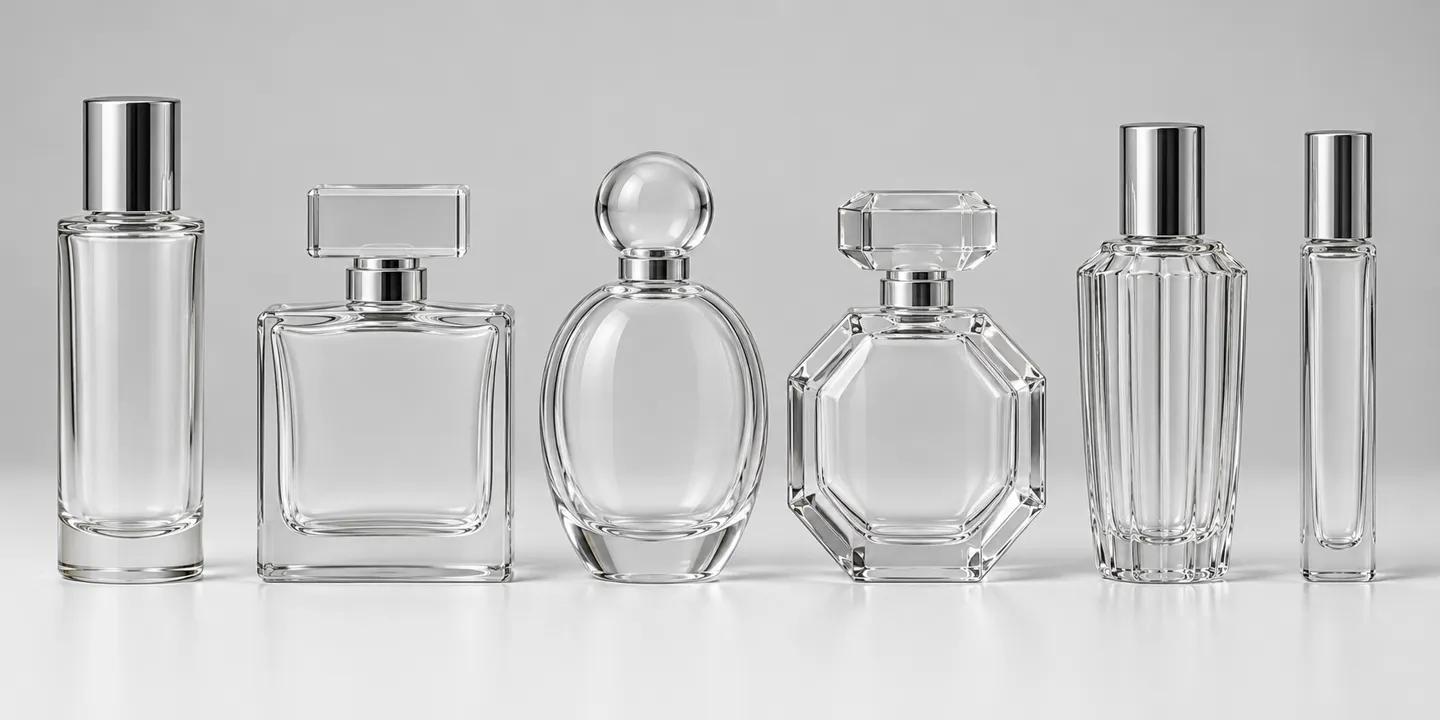
Style follows the silhouette. Minimalist and “quiet luxury” positioning pulls toward cylinders, rectangles, and frosted finishes. Ornate, gift-driven positioning, including much of the Middle East market, pulls toward faceted, crown, and heavily decorated bodies with metal or resin caps. Nature-led and artisan lines reach for sculptural forms and wooden caps. If you are building a vocabulary for supplier conversations, the table below is the shortest version.
The Nine Working Silhouettes
| Silhouette | Style read | Where it earns its place |
|---|---|---|
| Cylindrical / round | timeless, safe | scales from entry to prestige, 30-100 ml |
| Square / rectangular | architectural, modern | niche-brand default, 30-100 ml |
| Oval | softened geometry | feminine-leaning, 30-75 ml |
| Octagonal / faceted | light-catching, luxury signal | 50-100 ml |
| Crown | decorative shoulder | gift and Middle East strength, 50-100 ml |
| Fluted / prism | vertical rhythm on a rectangle | art-deco lean, 50-100 ml |
| Tall slim cylinder / prism | purse and travel carry | 10-30 ml |
| Sculptural / abstract | flagship and press shots | low volume |
| Heart | romance gifting niche | usually one-off molds |
Capacity sits on top of shape as a second decision. Ten, thirty, fifty, and one hundred milliliters carry most lines, and fifty milliliters is the size fragrance brands reorder most often. Across the industry’s order books, the 30, 50, and 100 ml trio accounts for roughly four in five bottles, while 200 and 250 ml stay niche. Custom shapes rarely go below ten milliliters because small molds get expensive per unit. Travel sprayers in shatterproof PET form their own portable branch, and reed diffuser bottles follow the same silhouette logic for home fragrance. Design trends come and go at the margins, pebbles this season, padded curves the next, but these nine families have held the shelf for decades.
The capacity numbers
50 ml
Most-reordered size in the category
4 in 5
Order-book share of the 30, 50, and 100 ml trio
10 ml
Practical floor for custom shapes
What a Shape Actually Costs: Three Paths to the Same Silhouette
A silhouette is not a product until you pick a production path, and the paths price out very differently. The same drawing can be a stock item shipped in three days, a light-custom order in two weeks, or a private mold that takes about forty days to fill. Fragrance packaging keeps growing with prestige demand. The cosmetic and perfumery glass bottle packaging market is projected at USD 2.59 billion in 2025, reaching USD 3.42 billion by 2031 (Mordor Intelligence, 2026). More people are fighting for factory slots, so the path you choose matters more every year.
Stock shapes: the 1,000-piece door
Stock silhouettes are tools that already exist. Published supplier terms typically start at 1,000 pieces per design, and in-stock orders commonly ship within three days. Most suppliers send free samples of stock designs, with you covering the courier. For a first launch, this path keeps your total risk near the price of one pallet.
Light customization: your color and logo in 10 to 15 days
Light customization takes a stock bottle and applies your brand. Pantone color coating, silk-screen logos, hot stamping, and frost effects all land in the 10 to 15 day window at the same 1,000-piece scale. Some suppliers stretch color and logo work to a month, so the published turnaround is worth confirming in writing. This is the path most growing brands actually live on, because the bottle stays proven while the shelf face becomes yours.
Full mold: about 40 days and a five-figure reality
A private mold is how a silhouette becomes exclusively yours. Expect several 3D design options within two weeks, mold making of 15 to 20 days, and roughly 40 days all-in before production. The minimum order changes category here: public supplier quotes for new glass molds commonly start around 10,000 pieces, and small-capacity molds can demand more. Free samples disappear on this path, since nobody funds a one-off mold.
The budget shock is real. A London-based founder with years of blending experience described phoning Chinese suppliers for his first house line and finding “a minimum order quantity of 10,000 bottles,” plus freight and mold fees on top (r/fragrance, 2022). The failure was not taste. It was picking a mold path at stock-stage finances.
Same silhouette, two clocks
≈ 3 days
from stock, shipped in about three days
≈ 40 days
all-in from a new mold, including 15 to 20 days of mold making
Ask which path your quote is on.
Three Paths to One Silhouette
| Path | Typical MOQ | Typical lead time | Free samples | Fits |
|---|---|---|---|---|
| Stock design | from 1,000 pieces | about 3 days | yes (courier paid by buyer) | first launches and market tests |
| Light custom (color, logo) | from 1,000 pieces | 10-15 days | on stock items only | growing brands needing shelf identity |
| Full custom mold | from about 10,000 pieces | about 40 days including 15-20 days mold making | no | established lines defending a signature shape |
Necks, Pumps and Caps: Making the Shape Work
A chosen silhouette still has to survive contact with the filling line, and the sequence runs neck, then seal, then spray, then cap. Get the order wrong and a beautiful shape turns into a warehouse problem.
The filling-line order
1
Neck
13 / 15 / 18 mm
2
Seal
screw or crimp
3
Spray
0.10 or 0.13 ml
4
Cap
500+ styles
Neck finish decides everything downstream
Perfume bottles standardize on 13, 15, and 18 mm necks, with 13 and 15 doing most of the volume. The neck size sets which sprayers, collars, and caps your bottle accepts, so it is the first number to confirm, before you fall in love with a shoulder curve. Two shapes that look identical can carry different necks, and that difference quietly controls your entire component chain.
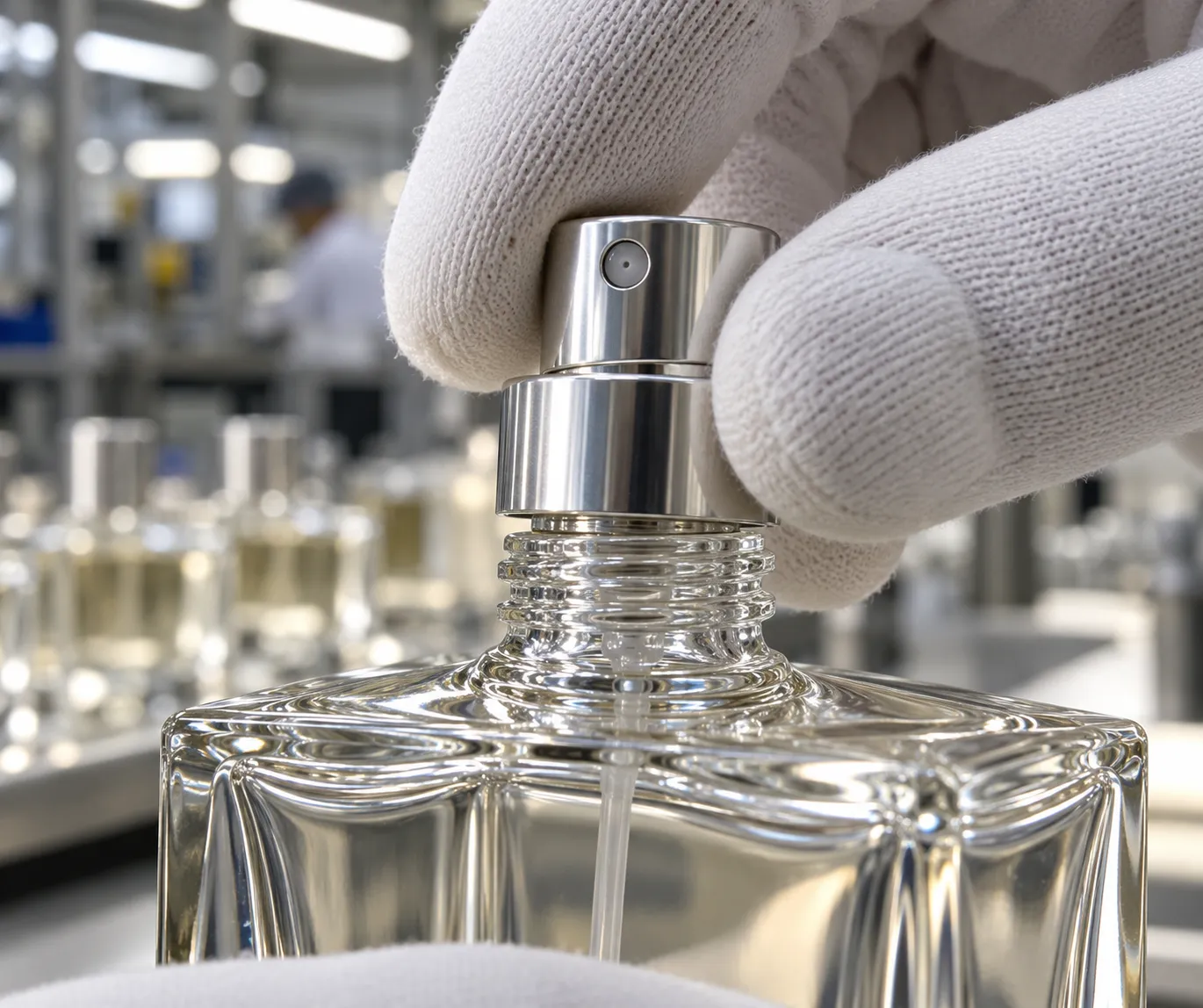
Screw or crimp: the filling line decides
Screw pumps thread on and can be removed, which suits hand-filling workshops and refill-friendly positioning. Crimp pumps press on permanently, look cleaner, cannot be reused, and carry the mid-to-high-end margin. Markets that fill by hand, including much of Southeast Asia and the Middle East’s smaller workshops, need screw seals because they lack crimping machines. Automated lines prefer crimp for speed and tamper evidence.
Screw vs Crimp at a Glance
| Aspect | Screw pump | Crimp pump |
|---|---|---|
| Seal | threaded | removable |
| Reuse | refillable | aftercare friendly |
| Filling | hand or semi-auto lines | |
| Market read | value and refill positioning | |
| Margin | entry-leaning | |
Mist, angle, and the cap family
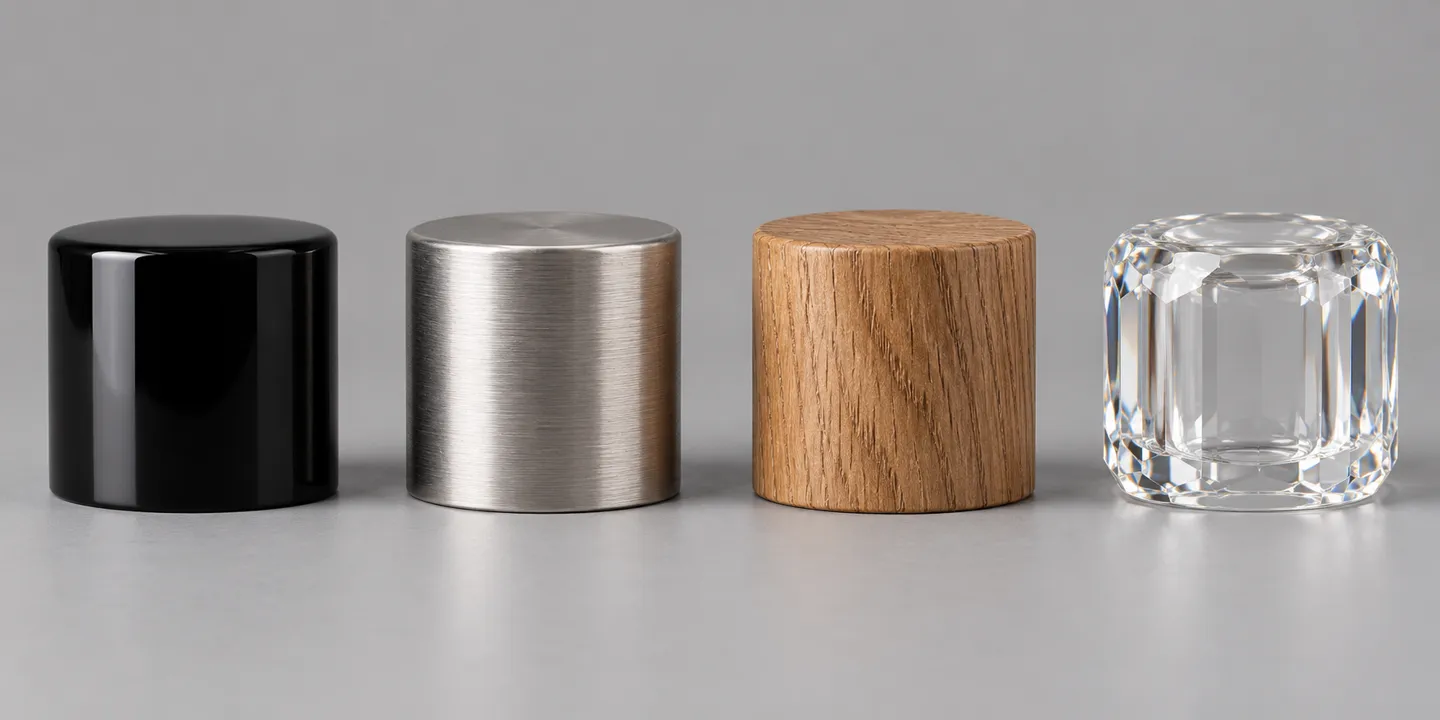
Spray feel is measurable, so specify it. Standard dosing runs at 0.10 or 0.13 milliliters per press, with 30 or 45 degree spray angles, and fine-mist variants exist for a drier, more even cloud. Caps are the cheapest upgrade a shape gets: established catalogs run past 500 styles across plastic, zinc alloy, resin, wood, stone, and even cement or glass.
Five checks keep a shape honest before you commit to it, and each one traces back to a number a supplier can confirm in writing.
- Neck size: confirm 13, 15, or 18 mm against the pump and collar stock you plan to reuse.
- Seal type: match screw or crimp to your filling line, not to a sample’s look.
- Mist spec: set dosage (0.10 or 0.13 ml) and spray angle (30 or 45 degrees) in the purchase order.
- Cap material: pick plastic, zinc alloy, resin, wood, or stone to your price tier.
- Filled sample: test leak and spray behavior before the bulk run.
Where Each Shape Sells: Markets, Risks and Boundaries
Shapes do not sell evenly across regions, and the differences are money. European and North American buyers lean minimal: clean cylinders and rectangles, frosted or clear glass, quiet caps. Middle Eastern buyers reward ornament: faceted bodies, crown shoulders, metal-heavy caps, designs that read opulent on a dresser. Southeast Asian buyers watch price first and treat mid-quality, simple shapes as volume work. Shoppers themselves vote with their wallets, and fragrance forum threads are full of readers refusing well-reviewed perfumes over bottles they find ugly (r/fragrance, 2024).
Two boundaries deserve a line before the matrix. First, shipping: glass travels badly in bulk, so individual cushion wrapping and sturdy export cartons are what keep a shape’s margin intact, and any damage claim should travel with photos or video. Second, imitation: distinctive bottle shapes can function as trade dress in major markets, and legal references use perfume bottles as the textbook example (Justia, 2026). A founder who asked about launching a bottle shaped like a well-known flacon got the practical answer: put an IP lawyer on both bottles before paying for molds (r/TRADEMARK, 2026). One changed ridge may not dodge a passing-off claim, and a new bottle now costs less than new molds, photos, stock and lawyers later. Run the IP check before the mold is cut, not after the stock lands.
Shape Families by Market and Boundary
| Shape family | Strongest fit | Fails or needs care when |
|---|---|---|
| Cylindrical / round | EU, US, SEA volume lines; refill and travel sets | premiumization asks for facets or decoration |
| Square / rectangular | EU and US niche launches | gifting markets read it as cold |
| Oval | feminine EU/US lines | weak shelf contrast in crowded minimal segments |
| Faceted / octagonal | Middle East, holiday gifting, prestige EU | budget SEA volume, freight weight |
| Crown | Middle East and celebratory gifting | minimal Nordic assortments |
| Fluted / prism | art-deco and vintage-leaning EU lines | trend cycles move on |
| Tall slim / travel | SEA price tiers, purse sprays, sampling | prestige living-room shelf presence |
| Sculptural / abstract | flagship and press | any volume play, mold cost per unit |
Reading Shapes as a Business
Stocking shapes is portfolio management, and one layer of it punishes the careless. Volume shapes, the cylinders and squares of the world, deserve depth: they turn quickly, fit three markets at once, and forgive a slow month. Margin shapes, crowns and facets and sculptural pieces, deserve restraint: they sell slower, justify higher marks, and reward being ordered against real demand rather than forecast optimism. Sinking cash into an ornate silhouette that one region loves is how a tidy catalog becomes a slow warehouse. Two practical rules keep the structure honest: hold most of your depth on 13 and 15 mm necks where the component world is widest, and treat a supplier’s published timelines, stock in days, custom color and logo in ten to fifteen, new mold in forty, as the check-line every quote has to beat or explain.
The Two-Layer Shape Portfolio
| Layer | Shapes | Stock depth | Customization | Job |
|---|---|---|---|---|
| Volume layer | cylinder, square, oval | deep, repeat-order | light (color, logo) | turnover and cash flow |
| Margin layer | faceted, crown, sculptural | shallow, demand-led | light to full (region-bound) | margin and differentiation |
That two-layer view is how we run our own shelves at HUA GLASS. Our in-stock shape library stays deep on cylinders and squares, so repeat orders ship in three days. Crown and faceted pieces move through color, logo, and mold work on the 10-to-15-day and 40-day clocks. Those three clocks are published terms, not aspirations, and every quote that leaves our desk carries them. When a shape conversation turns into numbers, we would rather be checked than believed.
If you are choosing a silhouette this quarter, run it through the three paths once: stock, light custom, mold. The shape you can afford is usually the one with a bill you have actually seen.
Put Your Silhouette on All Three Clocks
Send HUA GLASS your shape, capacity and neck finish. The quote that comes back prices stock, light custom and mold paths side by side, with the timelines in writing.
Request a Bottle QuoteReferences
- Mordor Intelligence. “Cosmetic and Perfumery Glass Bottle Packaging Market Size & Share Analysis.” 2026. https://www.mordorintelligence.com/industry-reports/cosmetic-perfumery-glass-bottle-packaging-market
- Justia. “Trade Dress Under the Law.” 2026. https://www.justia.com/intellectual-property/trademarks/trade-dress/
- r/fragrance. “How on earth do new brands produce bottles?” 2022. https://www.reddit.com/r/fragrance/comments/vr5esp/how_on_earth_do_new_brands_produce_bottles/
- r/fragrance. “Does bottle design influence your purchase?” 2024. https://www.reddit.com/r/fragrance/comments/1e0z84b/does_bottle_design_influence_your_purchase/
- r/TRADEMARK. “Can I use a similar perfume bottle?” 2026. https://www.reddit.com/r/TRADEMARK/comments/1wddy7u/can_i_use_a_similar_perfume_bottle/