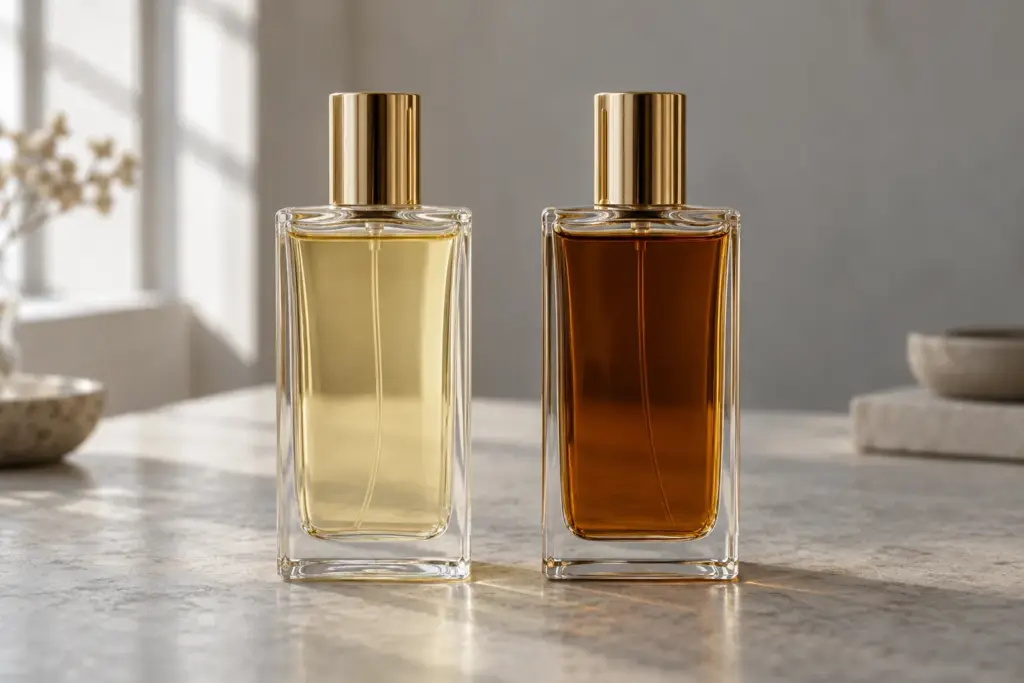
Two perfume bottles can hold the same 50 ml of fragrance and still be completely different products. One mists a fine cloud, one rolls oil onto the wrist, one has no sprayer at all and expects you to dab. The difference that matters is rarely the silhouette on the shelf. It is how the bottle dispenses, how it seals, and what that seal demands from your filling line.
The sections below move in that order. They cover the formats in any supplier catalog and the sealing structures behind them. Later sections cover what each customization tier costs, and the acceptance checks to set before a bulk order.
The Main Types of Perfume Bottles
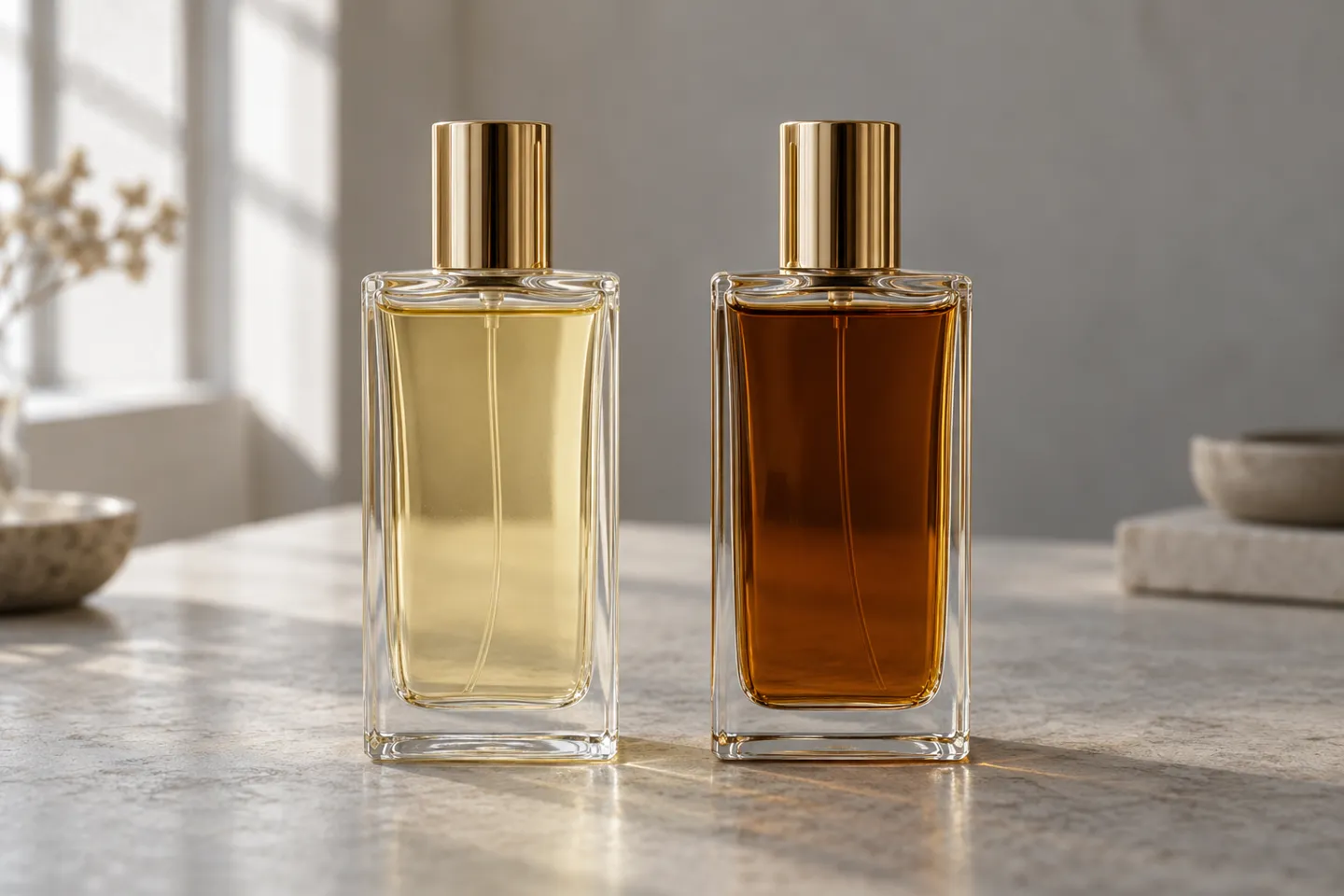
The spray bottle, usually called an atomizer, is the default of the market. A pump draws liquid up a dip tube and pushes it through a nozzle as a fine mist. Dosage per stroke is typically 1.0 or 1.3 ml, and fine-mist and delay-mist variants change how the cloud feels rather than how much comes out. Alcohol-based eau de parfum, eau de toilette and cologne almost all ship in this format.
Roll-on bottles trade the mist for a rolling ball, usually glass or steel. They suit perfume oils, attars and alcohol-free blends, where a spray would waste product and a wet applicator makes sense. Application lands exactly where you put it, which is why rollerballs keep a loyal following among oil brands despite divided opinions among everyday wearers (r/fragrance, 2025).
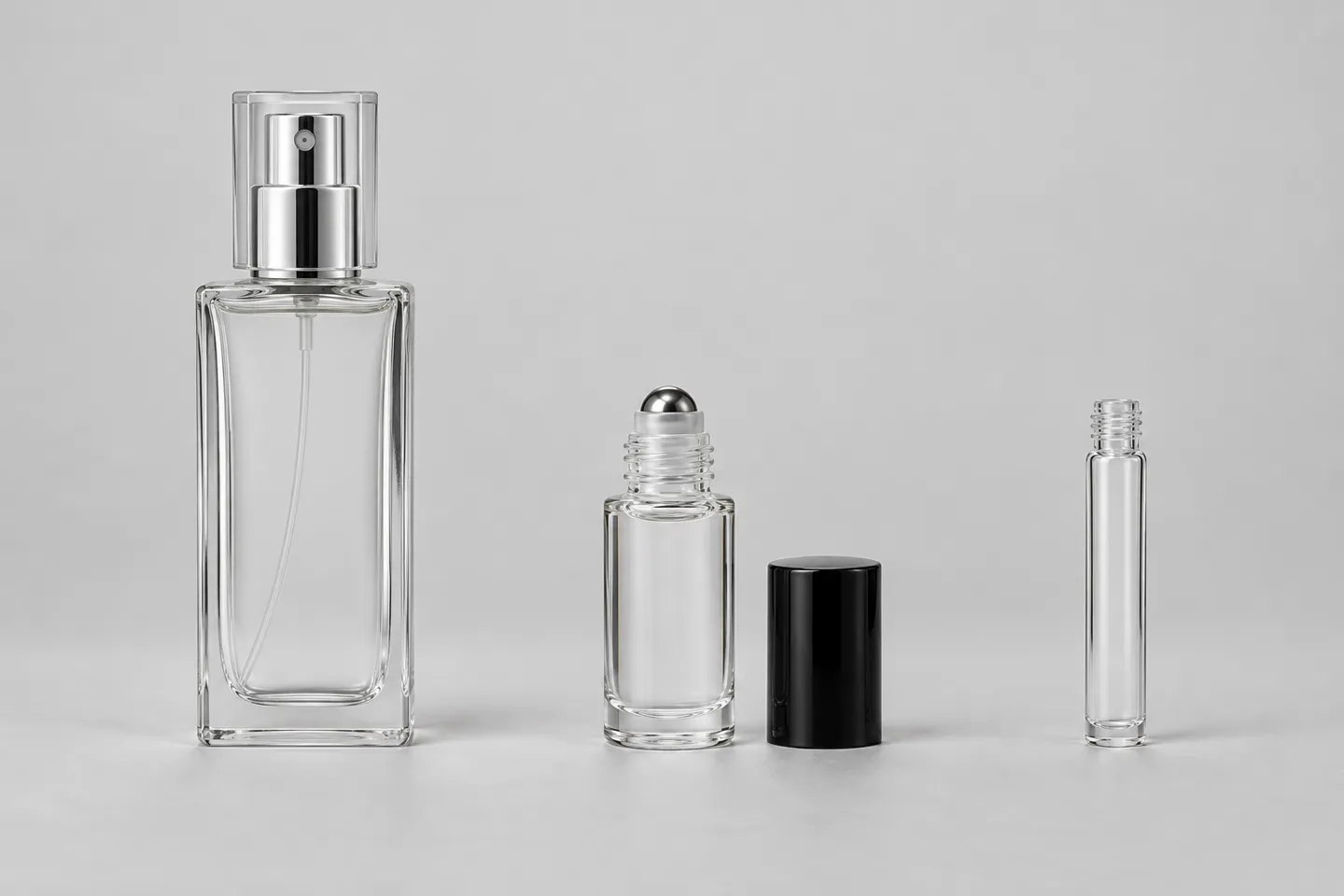
The no-sprayer bottle confuses people every day. Small sample vials without any pump are called dabbers: you dip a fingertip or use the inside of the cap to apply. Larger non-spray bottles filled with cologne-strength fragrance are usually called splash bottles. The two terms blur at the edges, and even perfume fans argue about where one ends and the other begins (r/Perfumes, 2024). The working distinction is simple: a dabber is a small apply-as-you-go vial, a splash is a pour-a-little bottle. Neither is obsolete, but both spill far more easily than a pump, so treat them as deliberate format choices rather than cost-saving defaults.
Around these three sit the supporting cast. Travel and mini formats run roughly 5 to 15 ml and feed the discovery-set and gift markets. Refillable formats, screw-open or cartridge style, keep growing as brands look for a repeat-purchase story. Figural and decorative bottles put the collectible front and center, and antique scent bottles are their own collecting world entirely. Shape names you will see in every catalog, rectangle, square, round, oval, heart and teardrop, mostly signal brand mood rather than function. Material tells a similar story. Glass dominates because it is inert and shows the liquid, while metal, plastic and ceramic hold niche positions.
Perfume bottle formats at a glance
| Format | How it dispenses | Best for | Watch out for |
|---|---|---|---|
| Spray / atomizer | Pump pushes liquid through a fine-mist nozzle | EDP, EDT, cologne, body mist | Needs crimp or screw sealing decision, see next section |
| Roll-on | Steel or glass ball wets the skin directly | Perfume oils, attars, travel touch-ups | Lower sillage, divided consumer opinion |
| Dabber / splash | Fingertip or pour application | Samples, cologne-strength formats, ritual positioning | Spills easily, no tamper seal |
| Travel / mini | Spray or roll-on in 5 to 15 ml | Discovery sets, gifts, airline-friendly sizes | Small volumes raise per-unit price |
| Refillable | Screw-open body or cartridge | Repeat purchase and sustainability lines | Seal must survive repeated opening |
| Figural / decorative | Any of the above | Collectible and gifting lines | Shape complexity drives mold cost |
Sealing Structures: How Each Bottle Dispenses and Refills
On the shelf, the format tells you what the bottle does. In production, the heavier question is the seal. The seal decides what equipment your filling process needs and whether the bottle can be reopened. Spray bottles, the format most perfume brands ship, split into two sealing families.
Crimp: sealed once, by machine
A crimp pump sits over the bottle neck and an aluminum collar is pressed inward all around, locking pump and bottle together permanently. The joint cannot be reopened without destroying it. That permanence is why crimp sealing reads as tamper evidence, and why it protects against leakage and evaporation in transit. The trade-off is equipment: crimping needs a pressing tool or an automated crimping head on the line. The most common crimp neck for fine fragrance is the 15 mm finish known as FEA15, and this is the default structure for mid and high-end perfume lines.
Screw: the low-equipment path
A screw pump threads onto a matching glass neck and can be taken off again by hand. That single property changes the economics for small producers. Filling can be done without a crimping machine, which is why screw bottles dominate small-batch workshops and in markets where manual filling is the norm. The neck accepts the same families of fine-mist pumps, and the bottle becomes genuinely refillable, which some brands turn into a selling point. The cost of that openness is honest to name. A screw bottle can be opened, topped up and resold by anyone. Premium positioning therefore leans on caps, cartons and branding rather than on the seal itself.
Neck finish: where most leaks are decided
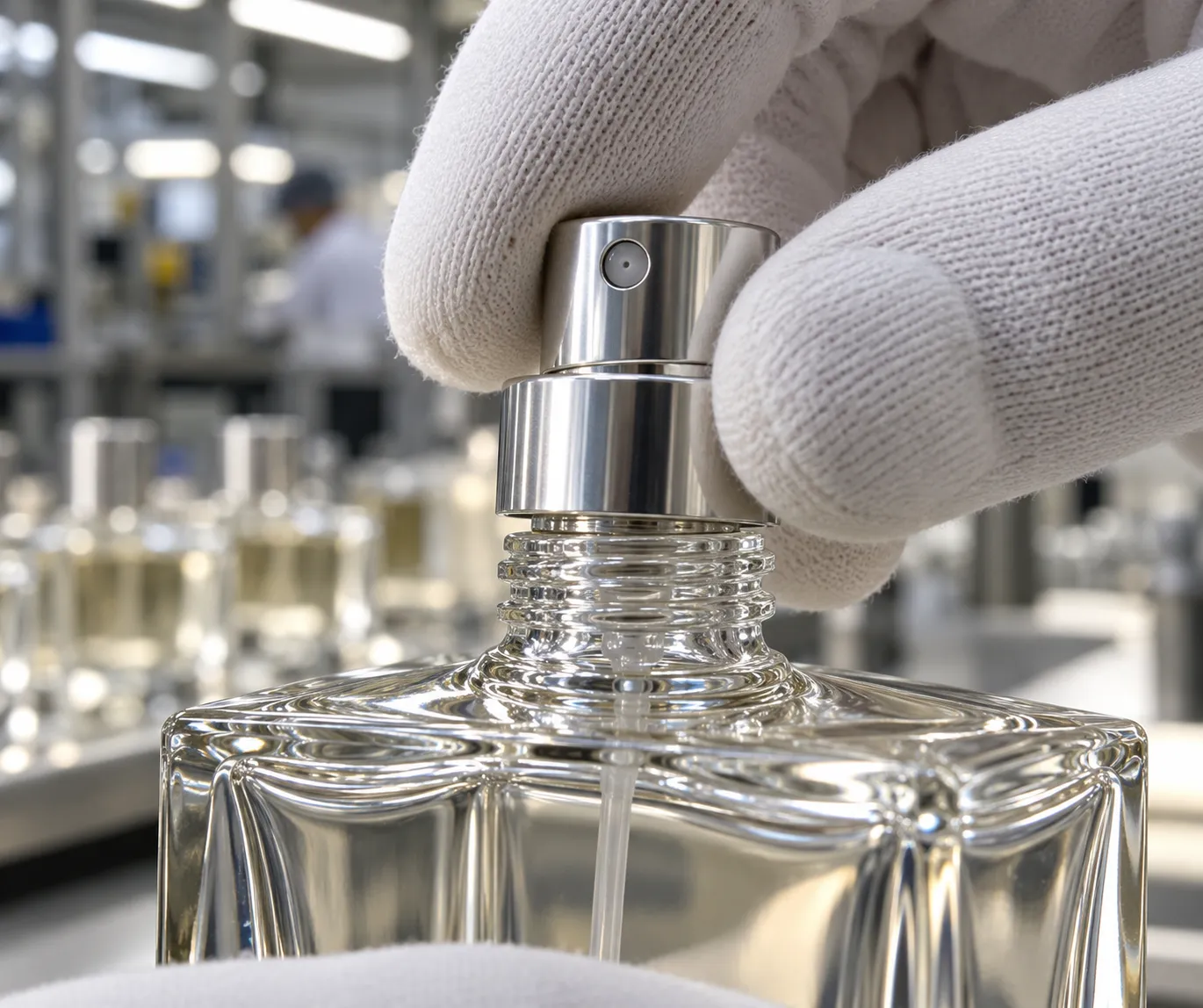
Either way, the pump and the bottle meet at the neck finish, and this is where leakage is usually won or lost. Neck sizes for perfume bottles run in a small set: 13, 15 and 18 mm are the common territory. A pump built for one finish will not seal properly on another. A mismatch of a few tenths of a millimeter between glass neck and pump collar shows up later as weeping around the seal or a spray that fades. Pump dosage, typically 1.0 or 1.3 ml per stroke, and mist quality are pump-side properties, but they only perform on a neck that fits.
Sealing structures compared
| Structure | Opening | Filling condition | Reuse and tamper | Positioning feel |
|---|---|---|---|---|
| Crimp (FEA15) | Permanent, destroyed on opening | Requires crimping tool or line | No reuse, strong tamper evidence | Mid to high-end default |
| Screw | Hand-openable, repeatable | No machine required, manual filling works | Genuinely refillable, weaker tamper story | Small batch and price-sensitive lines |
Before you commit: match the seal to your filling market
The check: whether your market fills on equipment or by hand.
Crimp in a hand-filling market stalls production before the first run.
Screw in a premium market quietly caps the price the shelf will accept.
Stock, Light Custom, or Full Mold: What Each Tier Really Takes
Once the format and seal are clear, the founder’s real question begins: which customization tier fits this stage of the brand. There are three, and each has a different price in pieces and in days.
Stock designs
Stock means the factory’s existing catalog, produced on running molds. At a supplier with a deep library this means over a thousand bottle designs, ordered from 1,000 pieces. Stock orders ship in about 3 days, and stock items come as free samples where you only cover shipping. For a first launch, stock buys you the cheapest possible test of a fragrance concept: real shelf feedback before real tooling money.

Light custom on a stock body
Light customization keeps the stock bottle and changes the identity: logo, color, surface finish. Silk screen printing, hot stamping, frosting, color coating and labels all land on a running bottle without new tooling. The quantity bar stays low, around 1,000 pieces, and the timeline near 10 to 15 days. This tier matters because of what it avoids. Ask in fragrance founder communities about custom glass and the reported reality is sobering. Embossed or fully custom bottles are commonly quoted from roughly 5,000 to 10,000 pieces, with tooling spend on top (r/DIYfragrance, 2025). A printed stock bottle reaches a branded look at a fraction of that gate.
The number to remember
1,000pieces
Ready designs and light customization start from here. Community-reported quotes for fully custom or embossed glass begin around 5,000 to 10,000 pieces, before tooling.
Full custom mold
A mold of your own buys a silhouette nobody else has. Expect multiple 3D concepts within about 14 days, mold making around 15 to 20 days, and roughly 40 days total to first production. Quantities for small-capacity or complex shapes can push minimums toward 10,000 to 20,000 pieces, because the mold only pays for itself across volume. One rule protects you here: design changes are practical only before production starts, and after that they cost money and time. Lock artwork, capacity and finish at the approval step.
The direction of the market reinforces the stock-first path. Travel sizes and refillables keep taking shelf space as discovery sets and sustainability stories grow. Suppliers keep feeding that appetite: busy catalog houses add on the order of 200 new designs a year. Testing a format from the catalog, then molding only the winner, matches how the shelf actually behaves.
Customization tiers and their boundaries
| Tier | Fits when | Boundary and what to confirm first |
|---|---|---|
| Stock | Testing a market, tight timeline, under 3,000 pieces | Confirm design is in current catalog and sample policy before comparing prices |
| Light custom | Brand identity matters, volume around 1,000+ | Confirm logo process (print, stamp, frost) matches your artwork and finish expectations |
| Full mold | Proven seller needing exclusivity | Confirm mold ownership, 40-day timeline, and quantity minimums in writing before paying tooling |
Send your quantity, artwork and timeline, and get a stock or custom recommendation with samples before you commit.
Ask Which Tier FitsSpecs and Acceptance: Sizes, Caps and the Tests That Prevent Leaks
Capacity is the spec buyers argue about least and regret most. Across the market the volumes that sell most are 30, 50 and 100 ml, with 10 ml doing steady work in travel and discovery formats (Sarochem, 2026). Below 30 ml the per-unit price climbs fast, and above 100 ml the buyer pool thins out. Choose from the volume ladder the market already understands before reaching for an unusual size.
The volume ladder buyers already know
10 ml
Travel and discovery
Steady work in 5 to 15 ml mini formats
30 ml
Entry retail
Per-unit price climbs below this
50 ml
The volume anchor
The market’s default EDP size
100 ml
Premium ceiling
The buyer pool thins above this
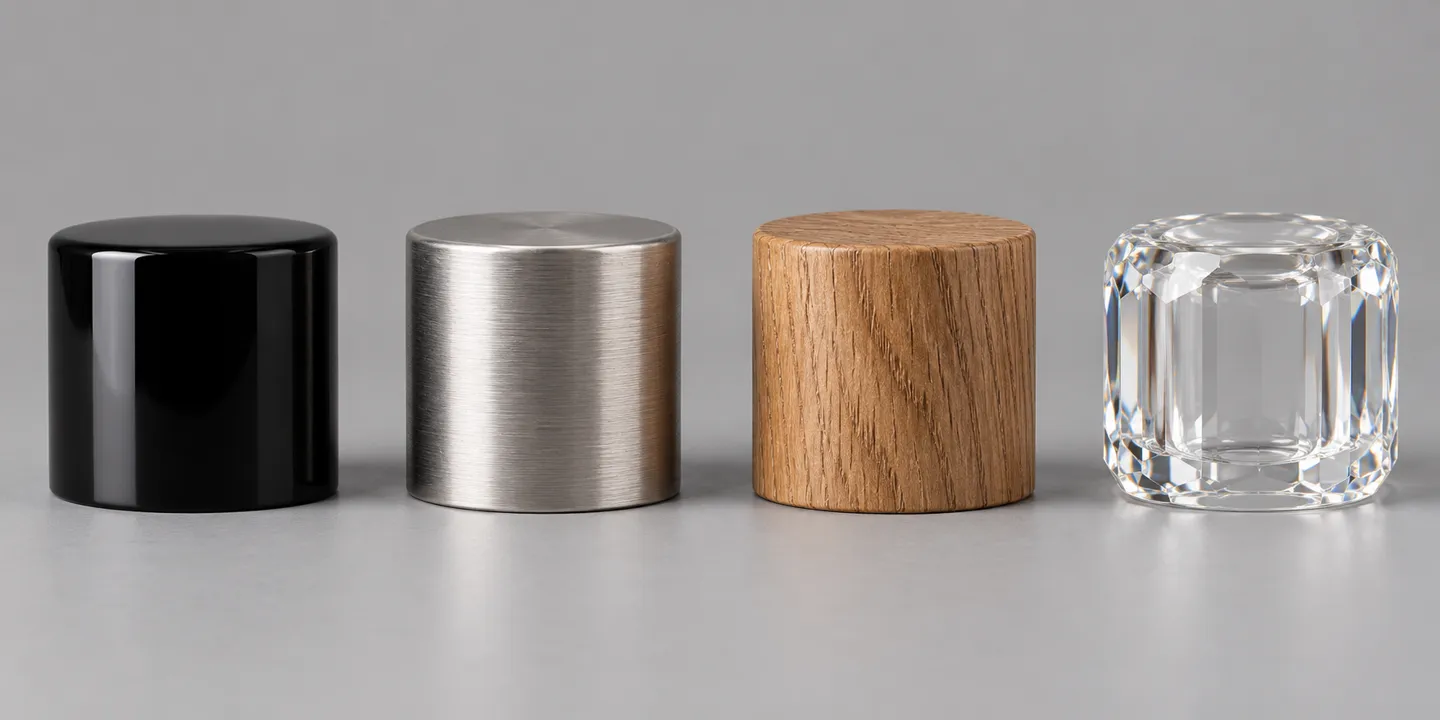
Cap material signals price tier faster than the bottle does. Resin and plastic caps carry entry and mid lines. Zinc alloy (Zamac) reads as mid to high. Wood or glass caps give a natural or jewel-like finish that photographs well. Wall thickness follows the mold, not a wish: a heavy-bottomed bottle feels premium because the mold puts glass there, so weight is a spec to request, not an accident.
The failures worth planning against are four. Leaks trace back to neck and pump fit. Spills trace back to format choice, dabbers and splash bottles above all. Fading or sputtering spray traces back to pump quality and dosage consistency. Scratches and haze trace back to glass grade and handling. Each failure has a matching test a supplier can run before shipment, which turns quality from a promise into a checklist.
Acceptance checks to request from your supplier
- Leak resistance test
- Pull-out force on the pump
- Crimping quality inspection
- Spray performance and dosage consistency
- Print adhesion
- Dimensional, weight and capacity measurement
- Annealing stress inspection per ASTM C148 (ASTM International)
- Four-stage full inspection from molding to packing
Shipping protection belongs in the same conversation. Small quantities should travel individually cushioned in sturdy export cartons, and that packaging standard is worth writing into the purchase terms rather than hoping for. Glass survives distribution when someone has decided it should.
Reading the Market by Sealing Structure
For distributors and resellers, the types stop being a taxonomy and become an inventory question. The logic runs in one line. Sealing structure decides the filling ecosystem, filling ecosystems differ by market, and inventory should therefore be arranged by sealing structure first. A crimp bottle belongs where filling lines run and buyers pay for the tamper-evident seal. A screw bottle belongs where filling is manual or equipment is scarce, and where the base of the price pyramid sits.
The stance worth taking: stock the two structures as different product lines, not as one “spray bottle” family. Crimp formats feed the mid and high-end tier, where permanence and leak protection justify price. Screw formats feed the volume tier, where the ability to fill by hand is often the entire reason the order exists. Shape decides whether a bottle sells. Sealing structure decides where it can sell at all.
Market tendencies by supply-side experience
| Market | Tendency | Sealing line that fits |
|---|---|---|
| Europe and US | Cleaner minimal design, quality-led, smaller orders | Crimp-led mid and high-end |
| Southeast Asia | Price-sensitive, volume-led | Screw-led base lines, hand filling common |
| Middle East | Ornate design, large caps, intense price competition | Both, segmented sharply by price tier |
Underneath the structure sits the supply condition that makes it workable. The catalog needs to cover both structures across shapes and caps, and restock has to run fast enough to keep the winners in stock. Breadth plus days-not-weeks replenishment is the real benchmark there. Hold every packaging partner against it.
If you want to test your market against both structures, HUA GLASS keeps 1,000+ ready-to-ship designs and 500+ cap styles in its perfume bottle collection. Stock orders ship in about 3 days.
Get Bottle Matches and a Quote for Your Line
Send your format, capacity and sealing structure. HUA GLASS replies with matching designs, samples and pricing from 1,000 pieces.
Request a QuoteReferences
- r/DIYfragrance. “Glass bottles with embossed logo without a 10,000+ piece MOQ?” 2025. https://www.reddit.com/r/DIYfragrance/comments/1n204x0/glass_bottles_with_embossed_logo_without_a_10000/
- r/Perfumes. “i just got my replica samples but the bottles don’t have spray nozzles.” 2024. https://www.reddit.com/r/Perfumes/comments/1anoikx/i_just_got_my_replica_samples_but_the_bottles/
- r/fragrance. “Opinions on roll-on vs spray.” 2025. https://www.reddit.com/r/fragrance/comments/1kx3czx/opinions_on_rollon_vs_spray/
- ASTM International. “Standard Test Methods for Polariscopic Examination of Glass Containers (ASTM C148).” https://www.astm.org/products-services/standards-and-publications/standards/bos-standards.html?volume=15&year=2022