You can spend three weeks on a perfume label design, approve the proof, and place the order. Then the labels arrive and lift at the corner, or smear after a month on a shelf, or turn out not to fit the legal text you’re required to carry. None of those failures happen because the design was wrong. They happen because a label is not a print job. It is the last step of a decision about how your brand gets onto glass. By the time you open your design file, the bottle has already made half of that decision.
What Perfume Label Design Actually Decides
A pressure-sensitive label is three layers, not one: face stock (what you see), adhesive (what holds it), and a release liner (what it comes off). It is applied to the bottle, not printed into it.
That distinction matters, because five variables decide whether a label survives its first month: face stock × adhesive × print method × bottle surface × what’s inside the bottle. Get any one of them out of step and you get a label that looks fine on the day it’s applied. Three weeks later it fails, when rework is no longer cheap.
There is a fork here worth naming, because this topic attracts two very different readers. If you’re printing a handful of labels for yourself, none of the above applies. Free templates and downloaded label sheets are the right tools, and beauty is the entire specification. Design galleries and template libraries already serve that path well.
The moment you order a production batch, the specification splits. Face stock stops being a colour choice and becomes a material decision with a failure mode attached.
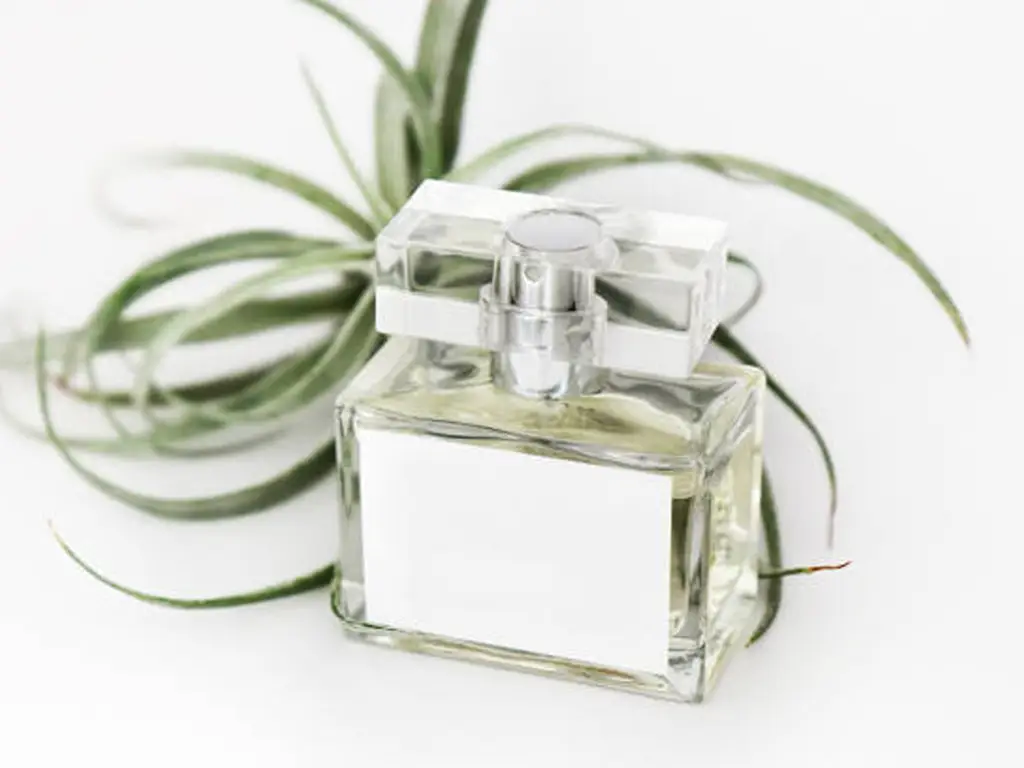
The Three Choices Inside a Perfume Label: Face Stock, Print Run, Layout
Face stock comes in five families. Paper covers uncoated, coated, textured, kraft, cotton and linen. Film covers PP, PET, PVC-vinyl and PE. Then come clear film, metallized, and holographic. Each has a different tolerance for water, alcohol and oil, and a different price position.
Face stock selection for perfume labels
| Face stock | Water resistance | Alcohol resistance | Oil resistance | Cost position | Where it fits |
|---|---|---|---|---|---|
| Uncoated paper | Low | Low | Low | Lowest | Dry, boxed products only; coated paper adds print quality but not resistance |
| Coated paper | Low–moderate | Low | Low–moderate | Low | Short-lived or highly sheltered products |
| Textured / kraft / cotton-linen | Low | Low | Low | Mid–high | Artisanal positioning where the product isn’t handled wet |
| BOPP (polypropylene) | High | Moderate–high | High | Mid | The default working choice for fragrance |
| PET (polyester) | High | High | High | Higher | Premium and long-shelf-life fragrance lines |
| PVC-vinyl | High | Moderate | Moderate | Mid | Wraps well around tight curvature |
| Clear film (PP or PET) | High | Moderate–high | High | Higher | A “no-label” look where the glass itself is the design |
| Metallized / holographic | High | Moderate | High | Higher | Accent use; usually not full-wrap |
Print run determines who can print it at all. Digital printing carries no plates, so 100, 500 and 1,000 labels all price sensibly per label. Roll labels at a 1,000-piece run commonly land around $0.07–$0.09 per label. Flexographic printing needs a plate for every colour. That turns setup into a fixed cost and pushes the sensible entry point up to roughly 3,000 labels per SKU.
Layout decides how much information the bottle can carry. A front label carries branding. A back label carries ingredients and legal text. You can run the two as a pair, use a wrap-around for maximum area, or give a neck, shoulder or base label a job of its own.
Sizing is measured off the bottle, never designed in the abstract. Wrap a strip of paper around the bottle at its widest point, mark the overlap, and subtract 3–6 mm so the label doesn’t chase itself. Then measure the usable height from shoulder to the start of the base curve. A 30 ml cylinder typically runs a front label around 35 × 55 mm; a 50 ml bottle, a wrap-around around 50 × 75 mm.
That measurement has to happen before the artwork, because mandatory content sets the minimum area. The label needs the brand and product name, net contents, ingredient declaration, manufacturer or distributor name and address, required warnings, barcode and batch code. In the US, net contents must appear in both fluid ounces and millilitres (FDA, Summary of Cosmetics Labeling Requirements).
One boundary belongs here as an action, not a caution. Confirm your alcohol content and whether the formula carries essential oils before choosing a face stock. Fragrance bases stain paper and bleed ink, so an alcohol-based eau de parfum will not tolerate a paper label however good the print quality. Oil-based attars fail on a different axis again. A specification that worked for one does not transfer to the other.
Should This Bottle Carry a Label at All?
The Decoration Method Axis
A label is one value on a longer axis, and it is worth seeing the whole axis before committing.
The set is long: pressure-sensitive label · silk screen printing · hot stamping (foil) · UV direct printing · pad printing · laser etching · sandblasting · spray coating and electroplating · inner printing. Inner printing puts the design on the inside of the glass, where it reads through. Shrink sleeves and wet-glue labels belong here too, but they serve plastic bottles and high-volume fast-moving lines.
Five questions separate the rest. How big is the batch? How many colours? How curved is the bottle? How often does the artwork change? And do you need a metallic finish?
Decoration methods for perfume bottles
| Method | Sensible batch size | Colour ceiling | Complex artwork | Metallic look | Cost of changing artwork | Curved-surface fit |
|---|---|---|---|---|---|---|
| Pressure-sensitive label | From ~100 (digital) to 3,000+ (flexo) | Full colour | Yes | Via metallized stock | Print plate and die | Good on cylinders; needs care on facets |
| Silk screen printing | ~2,000 for up to 4 colours; ~10,000 for 5–6 | Low (each colour is a separate screen) | Limited, flat shapes | No | New screen per colour ($50–$150 each) | Good; follows curvature well |
| Hot stamping (foil) | ~1,000–3,000 | 1 metallic colour | No | Yes | New die ($80–$250) | Good on flat and gently curved faces |
| UV direct printing | Small to mid | Full colour | Yes | No | Digital, no plate | Fair; depends on bottle geometry |
| Laser etching / sandblasting | Mid to high | 1 tone | No | Frosted white | Programme change only | Good on cylinders and flat panels |
| Spray coating / electroplating | Mid to high | Whole-bottle tone | n/a (no artwork) | Yes, as an overall finish | Colour batch only | Full coverage, any shape |
| Inner printing | Mid to high | Full colour | Yes | No | New print plate | Best on flat-fronted bottles |
The Hidden Cost on Both Sides
The part that never shows up in a per-unit quote runs in opposite directions on each side.
On the label side, the hidden cost is change. Every artwork revision means a new plate, and often a new die. Across a full year of seasonal or regional variants, that recurring setup can dwarf the printing itself. One comparison of roll-label quotes found a quote that looked cheaper per label but carried a $380 die fee and a 5,000-label minimum behind it.
On the direct-print side, the hidden cost is colour count and minimum batch. Silk screen printing needs a separate screen for every colour. That is why the minimum climbs from around 2,000 pieces for up to four colours to roughly 10,000 for five or six. Combine two decoration methods on one bottle and the higher of the two minimums governs the whole run.
Which inverts the assumption most first-time brands start with. “A label is cheaper” holds when your colours are many, your runs are small, and your artwork changes often. Once your colours are few, your runs are large, and your design stays put for years, direct printing’s per-unit cost falls below the label’s and keeps falling. You pay the setup once, then amortise it across a much longer run.
Four Routes to an Actual Label
There is no single recommendation here, only thresholds.
Four routes to an actual label
| Route | Entry threshold | What it buys you | The catch |
|---|---|---|---|
| Print them yourself | A handful of units | Immediate turnaround, lowest cash outlay | Not resistant to alcohol unless you buy film stock and laminate |
| Online roll-label printer | From a few hundred labels | Digital, no plates, sensible per-label pricing at 1,000 | You own the artwork compliance; no one checks the bottle |
| Local print shop | A few hundred upward | You hand over the problem and collect a roll | Fewer material options; you still need to confirm bottle compatibility |
| Bundled with the packaging supplier | Same order as the bottle | Bottle, decoration and label land as one specification | Only works if the supplier actually lists labeling |
Your Bottle Surface Decides: The Placement Matrix
Why Frosted, Coated and Metallized Glass Behaves Differently
Glass is a high-surface-energy substrate. Standard pressure-sensitive adhesives wet it immediately and hold. That makes clear glass the friendliest surface a label will ever meet.
Frosted, sandblasted, spray-coated, gradient and electroplated finishes are a different story. There, your adhesive is no longer bonding to glass. It is bonding to a cured coating film on top of glass. The label isn’t failing; it’s doing exactly what the surface allows.
That is the first rule of this whole topic, and it is the one most brands learn the expensive way.
The rule
Surface finish decides whether a label lifts. Label material decides how it looks.
The same label, on the same bottle shape, behaves differently once the glass is frosted, coated or electroplated.
Geometry is the second variable. A cylinder gives continuous curvature and is the easiest shape to label. Flat and faceted bottles have edge lines the artwork should stay off. Oval bottles and tapered shoulders need higher initial tack because the label has to hold on a surface that is still curving away. The shoulder and neck transition is the worst place on any bottle to put primary artwork.
The Order of Operations You Cannot Reverse
Decorated glass goes through a bake. Screen-printed glass is baked to cure the ink. Spray-coated glass is high-temperature baked and then cooled. Both steps happen at temperatures a pressure-sensitive label will not survive.
The sequence is therefore fixed, and it is not symmetrical:
The order you cannot reverse
All glass finishing (screen printing, spray coating, frosting, electroplating) must be completed BEFORE labeling. You cannot label first and then send the bottle through the bake. If the bottle decoration and the labeling sit with two different suppliers, ask at quotation stage whether the bottle still has a finishing step coming. Getting this order wrong is not a scheduling problem. It is a total loss of the labels.
The question to ask in your first email: does this bottle still have a heat step ahead of it? If yes, the label goes last, and the label supplier needs to know that before quoting.
The second consequence is that adhesion is testable. Four checks apply: print adhesion, spray-coating adhesion, scratch resistance, and colour consistency across the batch. If your supplier’s process doesn’t name those tests, ask what it runs instead.
The Placement Matrix
Bottle surface scenario × decoration method × what to confirm
| Bottle surface | Methods that work | What to confirm first |
|---|---|---|
| Clear glass, cylindrical | Any: label, silk screen, hot stamp, UV direct, laser | Confirm the neck finish and the full circumference before sizing the label |
| Clear glass, flat or faceted | Label, silk screen, hot stamp, UV direct | Confirm where the edge lines fall so artwork avoids them |
| Frosted or sandblasted | Silk screen, hot stamp, laser; labels only with a high-tack adhesive | Confirm the surface treatment type and roughness, then set the adhesive and the adhesion test |
| Spray-coated, semi-translucent or gradient | Silk screen, hot stamp; labels need a high-tack adhesive and an adhesion test | Confirm whether the coating is fully cured and whether it has been baked |
| Electroplated or metallized | Silk screen or laser over the plating | Confirm whether the plated face needs a second decoration pass |
| Inner-printed glass | No external decoration needed on the printed face | Confirm which faces carry the print and which stay clear |
| Miniature 10–15 ml travel bottles | Label (small) or silk screen | Work out the minimum area for mandatory content first; move legal text to the outer box if it won’t fit |
One further boundary: bottle wall thickness varies within a single mould, so a heavier bottle gets a thicker base. The same label can therefore meet a slightly different surface from one batch of glass to the next. Set the allowance against the thinnest batch in the run, not the average.
Locking a Repeatable Label Spec — and Selling Into Two Markets
The failure that catches scaling brands is not a bad first batch. It’s a good first batch followed by a lifting third one. That happens when the spec was never locked. The face stock gets written as “waterproof” instead of a material and grade. Nobody records the die number. The unwind direction comes out reversed.
Seven fields that make a spec repeatable
Face stock material and grade
Exact dimensions
Unwind direction
Plate or die number
Colour reference
The adhesion and colour-consistency tests to be run
A spare allowance for application losses
Any one of those drifting drifts the result.
Then there is the part of the label that isn’t a design decision at all.
In the United States, an entire fragrance blend may still be declared as the single word “Fragrance” or “Parfum.” Net contents must appear in both fluid ounces and millilitres. The label must also carry a contact through which adverse-event reports can reach the responsible person (FDA, Summary of Cosmetics Labeling Requirements).
In the European Union, named disclosure is required above a threshold: 0.001% (10 ppm) in leave-on products, 0.01% (100 ppm) in rinse-off (EUR-Lex, Commission Regulation (EU) 2023/1545).
Regulation (EU) 2023/1545 is the one to plan around, and its two dates are routinely reported as if they were the same thing. They are not.
Two dates, two different cases
Named fragrance allergens go from 26 to more than 80, including several botanical extracts by name.
31 July 2026, placing on the market
Any product first made available on the EU market from this date must carry the expanded declaration.
31 July 2028, making available
Stock already on the EU market may sell through until this date.
The distinction that matters: “placing on the market” is the first making available of a unit. A NEW BATCH of a long-running SKU first made available after 31 July 2026 counts as a new placement. It does not get the 2028 cushion.
Great Britain did not adopt 2023/1545 and still works from the original list. UK authorities do accept a label carrying the fuller EU declaration as compliant, so a single label printed to the longer list can serve both markets. In the US, MoCRA tells the FDA to write fragrance-allergen disclosure rules, and that rule has slipped repeatedly. The 2026 regulatory agenda now targets a proposed rule for November 2026 (FDA, Modernization of Cosmetics Regulation Act of 2022). 2026 is a preparation year in the US, not a compliance year.
The working action that follows: lay the label out against the strictest market’s list first, then decide whether you need two versions. Area is fixed at the design stage. Everything after that is re-plating, a new die, and a reprint.
What Label Decisions Cost a Brand That’s Scaling
Step back and a pattern appears. Label survival is decided by five variables acting together. Surface treatment moves adhesion more than material does, and the bake has to happen before the label goes on. Regulatory expansion changes how much area the same design must cover. None of these are artwork problems.
That lands hardest on brands in the middle. Below roughly a thousand units, printing labels yourself is cheap and reversible. Above tens of thousands, a brand can invest in direct-print tooling and amortise it. In between sits the 1,000-to-20,000-unit zone most scaling fragrance brands actually occupy. There you are past the point where homemade is acceptable and short of the volume that makes custom tooling pay. That is where the choice of decoration method has the widest range of outcomes and the narrowest margin for getting it wrong.
The remedies are all losses. If adhesion fails after printing, your options are to laminate, change adhesive, or reprint. If the area turns out too small for a market’s disclosure list, it is a new plate, a new die and a new print run.
So the cheapest thing to change is the order in which you decide. Bottle and surface finish first. Decoration method second, label or direct print. Artwork last, once you know how much area the strictest market leaves you and what the surface will actually hold. Put the adhesion and colour-consistency tests, the spare allowance, the unwind direction and the colour reference into the purchase document at the same time. That way the third batch has something to match against.
A note on how HUA GLASS can help: we can help you source and customize labels to work with your bottle project. You provide the brand artwork or work with your designer; we help turn the label requirements into a bottle-compatible specification. Our customization sheet runs ten axes in one pass: shape, capacity, Pantone-matched colour, neck opening, logo application, surface polishing, finishing technique, spray pump, cap and packaging. Label material, size, finish and application requirements can be coordinated with the bottle surface finish, so adhesion and decoration are considered together instead of one after the other. Stock items ship in three days, colour and logo work on an existing bottle takes 10–15 days, and MOQ starts at 1,000 pieces. If you’re choosing a bottle and its label at the same time, custom glass bottle packaging shows what fits on one order.
Match Your Bottle With the Right Label
Share your bottle, label requirements and artwork. We can help source and customize compatible labels, then coordinate the bottle, finish and packaging in one specification.
Ask About Bottle & Label CustomizationReferences
- European Commission. “Commission Regulation (EU) 2023/1545 — amending Annex III to Regulation (EC) No 1223/2009 as regards labelling of fragrance allergens.” 2023. https://eur-lex.europa.eu/legal-content/EN/TXT/?uri=CELEX:32023R1545
- U.S. Food and Drug Administration. “Summary of Cosmetics Labeling Requirements.” https://www.fda.gov/cosmetics/cosmetics-labeling-regulations/summary-cosmetics-labeling-requirements
- U.S. Food and Drug Administration. “Modernization of Cosmetics Regulation Act of 2022 (MoCRA).” https://www.fda.gov/cosmetics/cosmetics-laws-regulations/modernization-cosmetics-regulation-act-2022
- HUA GLASS. “Custom Glass Bottles.” https://www.huaglass.com/custom/
- HUA GLASS. “Quality.” https://www.huaglass.com/quality/
- HUA GLASS. “Contact Us.” https://www.huaglass.com/contact-us/
- HUA GLASS. https://www.huaglass.com/