What “Bottle Design” Really Means: Four Layers, Not One Look
Run your eye down a shelf of fragrances and you are looking at four separate decisions stacked on top of each other. The glass body: its shape, its capacity, the way the weight sits in the base. The surface: polish, colour, the way light passes through it or stops at it. The graphics: the name, the mark, the material that mark is made of. And the closure: neck, pump and cap, the part your hand actually meets.
Four layers, and only one of them needs a mould
Most people arrive at “bottle design” looking for a single answer. They want the most beautiful silhouette, the most recognisable form. What they are actually looking at is four layers, and they are calling it one thing. That flattening is where sourcing mistakes begin. The four layers do not behave the same way, and they do not cost the same thing. Three of them can be changed on a bottle that already exists. One of them cannot.
Look at the bottles people name when they talk about great design. Mugler’s Angel is almost entirely a Layer 1 achievement: a star-shaped body that could not have been produced any other way. Guerlain’s bee bottle tells the same story, where the form itself carries the meaning. Chanel No. 5 runs the opposite play. A plain rectangular body does almost nothing at Layer 1, letting a label, a typeface and a stopper carry the identity. Anna Sui, the recurring answer in enthusiast threads asking which houses make the most playful bottles, pushes hardest at Layer 4, where the cap becomes the character.
All of those are good design. What separates them is which layer each one chose to spend its money on, and that choice decides whether your bottle ever reaches a shelf. The layers are numbered here in the order they lock in, not the order they matter. Layer 1 locks first and locks hardest.
Layer 1 — The Glass Body: Where Shape, Capacity and Mould Cost Are Settled Together
Shape Families, and What Each One Costs You in Glass Weight
Perfume bottles resolve into a small number of shape families. Each one carries a different relationship between the mould and the finished object.
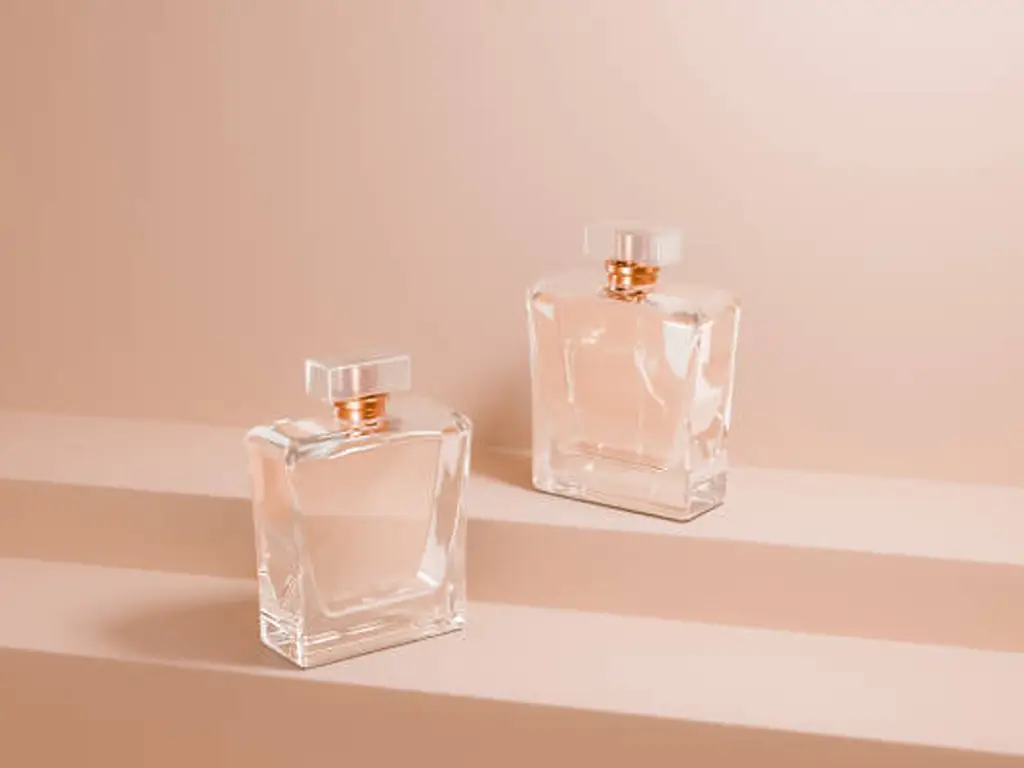
Round and oval bodies distribute glass most evenly, which makes them the most forgiving to produce and the most common choice for a first run. Square and rectangular forms read as architectural and give you more front panel for graphics. The corners are also where wall thickness is hardest to hold consistent. Cylindrical bottles are the workhorse of the contemporary market: clean, neutral, and the family where stock availability runs deepest. A single supplier’s cylindrical listings routinely stretch into the dozens of pages. Faceted and polyhedral forms get their character from edge geometry rather than silhouette, and every facet is a place the mould has to be exact. Sculptural and irregular shapes are the Layer 1 extreme: the star, the flower, the object that is not obviously a bottle until you look twice. They are the reason a mould exists at all, rather than a shape being chosen from a catalogue. Thick-based bodies are their own family, where a cube or cylinder carries its visual weight low. That is a deliberate design effect rather than a by-product.
One thing unites all six. The glass itself is chosen before the shape means anything. Perfume-grade glass is specified for clarity and hardness. A clear bottle that stays clear, and one that picks up fine scratches in transit, are separated largely by a material decision made on day one. It is not a finishing decision made at the end.
Capacity: The Mainstream Sizes, and the Small-Volume Mould Trap
Fragrance packaging customisation usually spans 10ml to 250ml. A handful of sizes carry almost all of the commercial volume: 30ml, 50ml and 100ml, plus 200ml and 250ml at the concentrated end of the market. If you are launching without a strong reason to do otherwise, you are choosing inside that set, and you are choosing from stock.
The trap sits at the small end, and it runs opposite to intuition. You would expect a smaller bottle to be cheaper and easier. Often it is the reverse. Custom shapes start around 10ml, but very small capacities frequently cannot be produced from an existing mould at all. They need one cut specifically for that size, and the minimum order attached to a new small-format mould is substantial, on the order of 20,000 pieces. Larger custom capacities carry a lower entry point, around 10,000 pieces. A brand that assumes “small bottle, small order” can find itself facing the largest minimum in its entire packaging plan.
Base Weight and Wall Thickness Are Mould Outputs, Not Dials
Here is the fact that no design tutorial will tell you, because design tutorials have never stood next to a mould.
You cannot dial wall thickness. You cannot dial base weight. Both are properties of the mould, decided when the mould is cut, and they come out the same on every bottle that mould ever produces. Molten glass leaves the furnace at around 1,600°C and is cut into uniform gobs. It is blown into the mould, then annealed, which means cooling it gradually so that internal stress does not stay locked into the glass and weaken it. By the time annealing is finished, the shape and the distribution of thickness are already determined. No finishing step adds glass to a base or thins a wall.
This reframes an entire class of design decision. “A heavier bottle feels more premium” is true. It is also not a lever you can pull on a bottle you did not commission a mould for. A heavy base is something you select, not something you specify. If a design concept depends on the bottle having a substantial, weighted foot, you are looking at Layer 1, and Layer 1 has a price structure of its own.
That price structure is three costs arriving at once: a mould charge, a minimum order quantity, and time. Colour and logo changes applied to an existing bottle are typically quoted in the region of 10–15 days. A full new-mould project takes roughly 40 days, of which mould production alone accounts for 15–20 days. Multiple 3D design concepts are usually delivered within about 14 days, and physical samples take 3–7 days.
What each design decision costs you in time
The shape you fell in love with in a reference image is a shape somebody paid a mould for. That is worth sitting with, because everything that follows is about the layers where that is not true.
Layers 2 and 3 — Surface and Graphics: Everything You Can Still Change, and Where the 2026 Trends Actually Land
Surface: Polish, Colour and Texture
Surface treatment is the layer that turns one mould into a dozen different products. Two polishing routes exist: fire polishing, which uses heat to smooth the glass, and hand polishing, which is exactly what it sounds like and carries a different cost profile. On top of the polish sit eight standard surface directions: glossy, matte, semi-transparent, opaque, frosted, gradient, metallic effect, and electroplating.
Two of those deserve a note. Semi-transparent colour is one of the highest-value surface choices available. A bottle that reads as deep black in one light and lets a glow through in another changes its relationship to the liquid inside, not just its colour. Gradient work is where you should expect a conversation about yield. A gradient that runs cleanly across a curved shoulder and one that bands slightly at the transition are the same specification on paper and different products on a shelf.
The important structural point is that surface effects stack, and stacking is not additive. Electroplating under a frosted top coat, matte over a metallic base, a gradient finished with a soft-touch layer. Each of those is a separate process pass, and each pass is its own opportunity for a reject. Cost and yield move together, and they move faster than the number of steps.
Graphics: Printed Into the Glass, or Applied On Top of It
Nine standard graphic routes are worth knowing. The useful way to hold them is not as a list of techniques but as two families.
Bonded to the glass: silk screen printing, spray coating, hot stamping in gold or silver, baked enamel, UV printing, and laser engraving. These go onto the bottle early and are cured onto it. Several pass through a baking stage that fuses the mark to the surface. They survive handling, washing and time. They also cannot be changed without changing the bottle.
Applied on top of the glass: metal labels and paper labels. These are produced separately and attached, which means they can be added late, revised cheaply and, increasingly, removed. A label is not a lesser graphic. It is a graphic with different failure modes and a different end-of-life story, and for a brand watching regulatory direction, that difference is not small.
Where the 2026 Trends Land — and Which Ones Never Touch Your Mould
Search for perfume bottle design trends and you will find the same six items everywhere: refillable systems, quiet-luxury minimalism, sculptural glass, mixed materials, tactile surfaces and sustainability. Every article presents them as a flat list, which is exactly what makes the list useless for planning. They are not peers. They land on different layers, and the layer a trend lands on decides what it costs you.
| Trend | Layer it lands on | Does it require a new mould? |
|---|---|---|
| Refillable and refill systems | Layer 4 — neck and closure geometry | No, if the refill mechanism works with a standard neck finish |
| Quiet luxury, minimal, high clarity | Layers 1 and 2 — restrained form, restrained colour | Only if you also change the form |
| Sculptural glass | Layer 1 — the body itself | Yes |
| Mixed materials: stone, wood, concrete caps | Layer 4 — the closure | No |
| Tactile surfaces: matte, soft-touch, frosted | Layer 2 — surface treatment | No |
| Sustainability and recyclability | Layers 1 and 4 — a compliance boundary | No, but it constrains choices at both |
Read down that last column and the practical question answers itself. Five of the six trends can be followed on a bottle that already exists. Only sculptural glass is a Layer 1 move, and it is the only one that arrives with a mould charge, a minimum order and roughly forty days attached.
One boundary on the sustainability line is worth flagging, because it is widely misreported. The EU’s Packaging and Packaging Waste Regulation, Regulation (EU) 2025/40, was published in January 2025 and most of its provisions apply from 12 August 2026. By 2030, packaging placed on the EU market must be either reusable or recyclable. Packaging whose recyclability rate falls below 70% will no longer count as recyclable from 2030, with that threshold rising to 80% from 2038. From 1 January 2030, packaging must also be reduced to the minimum size required. Double walls, false bottoms and unnecessary layers are prohibited, and void space in secondary and transport packaging is capped at 50% (European Commission).
Two common readings of that are wrong, and both are worth correcting before they reach a product brief. First, the regulation does not require perfume bottles to be refillable. Its reuse quotas cover beverage, transport, sales and e-commerce packaging, not fragrance or cosmetics. The accurate statement is that packaging must be reusable or recyclable, and a refill system is one route to the first of those. Second, it does not ban heavy glass or non-glass caps. What it does is make separability a question your EU buyer will eventually ask. If a stone or concrete cap is bonded to a glass body, can the two be separated when the packaging is disposed of? Design for Recycling guidance is due by 1 January 2028, so the honest position today is a question to put to your supplier, not a conclusion.
Layer 4 — Neck, Pump and Cap Are One Decision, Not Three
The closure is where most of the parameters live and where most of the mismatches happen. The reason is structural: neck, pump and cap are not three products you buy. They are one interface described three times.
The neck comes in 13mm, 15mm and 18mm, with 13mm and 15mm carrying most of the volume, and in two sealing types. Screw neck is the lower-cost route. It is also the one that matters in markets where filling is done by hand, because hand-filling equipment does not need the tooling that crimp closures demand. Crimp neck sits at the mid-to-high end and cannot be re-sealed once closed, which is precisely why it reads as more premium.
The pump follows from the neck: standard or fine mist, with actuation volumes of 0.10ml or 0.13ml per spray and spray angles of 30° or 45°.
The cap sits on top and is where the widest choice lives. There are more than 500 existing styles, spanning plastic, zinc alloy, aluminium, resin, natural wood, stone and cement. Magnetic closures are available, and more than ten surface finishes can be matched against the bottle. The families you see in stock listings are production items, not concept renders: abstract stone caps, marble-pattern resin spheres, snake-relief cylinders, aluminium magnetic caps.
| Component | Options | What it decides |
|---|---|---|
| Neck finish | 13mm / 15mm / 18mm; screw or crimp | Which filling equipment can be used, and whether the closure can be re-sealed |
| Pump | Standard or fine mist; 0.10ml or 0.13ml per actuation; 30° or 45° spray angle | Spray feel, and how much product leaves the bottle per press |
| Cap | 500+ styles; plastic, zinc alloy, aluminium, resin, wood, stone, cement; 10+ finishes | Perceived tier, hand-feel, and how complex the assembly becomes |
The coupling is the part that catches people. Change the neck and both the pump and the cap have to be re-verified. Change the pump and you have changed the spray volume the consumer receives per press, which may or may not suit the viscosity of what you are bottling. Change the cap for a heavier stone or metal design and you have changed the mass sitting on the neck, which is exactly what a shipping carton tests. None of these are defects. They are consequences, and they are predictable if you treat the closure as one decision and verify it as one decision.
The practical ordering is the reverse of how most people shop: settle the neck and the pump before you fall in love with a cap, not after.
Not sure which layer your design lands on?
One sentence on where your shape, finish and closure decisions are already defined — and where they aren’t.
Send your bottle briefWhen the Design Looks Right and Still Goes Wrong
Everything above comes down to a set of specific places where a bottle design that looks correct on screen fails in production. Use this as a check against your own brief.
| Design choice | Where it applies | How it fails | What to confirm with your supplier |
|---|---|---|---|
| Commissioning a new shape | Brand-defining form; volume already proven | Mould cost, minimum order and roughly 40 days arrive together, and are funded before a single unit sells | Ask whether an existing mould produces a shape close enough, before quoting a new one |
| Custom capacity below 30ml | Travel sizes, discovery formats, testers | Small-format moulds carry the largest minimums in the plan — on the order of 20,000 pieces | Confirm the minimum before designing around the size |
| Heavy base, weighted foot | Premium positioning | Base weight is a mould property, not a specification — it cannot be added to a stock body | Ask whether the weight effect exists on an existing mould |
| Electroplating or metallic finishes | High-impact shelf presence | Multi-pass finishing raises reject rates, and reject rates are quoted per pass | Ask for the yield, not only the unit price |
| Frosting plus hot stamping | Layered premium effects | Two processes, two passes, two chances of a reject; cost is not the sum of the two line items | Ask which combinations are run routinely |
| Stone, wood or concrete caps | Distinctive, tactile closures | Bonded non-glass components raise a separability question under EU packaging rules | Ask whether cap and body can be separated at end of life |
| Crimp neck | Mid-to-high-end positioning | Cannot be re-sealed, and needs crimping equipment rather than hand filling | Confirm your filler can crimp before committing to the neck |
| Applied labels | Late revision, fast market entry | Adhesion and durability behave differently from graphics bonded into the glass | Confirm adhesion testing was done on your specific surface finish |
| Refillable structure | Following the refillable trend | The mechanism must work with a standard neck finish, or it becomes a Layer 1 change | Ask whether the refill works on a stock neck |
The failure stories behind that table are not hypothetical. A founder writing in r/DIYfragrance described choosing a bottle at $0.80 per unit, only to find the minimum order was 10,000 pieces. “$8k gone already,” in their words, before a single bottle was filled (r/DIYfragrance). Another, in r/fragrance, brought a design they loved to manufacturers. Turning it into a sprayable bottle, they reported, was “nothing short of ‘impossible nightmare’.” The design had never been tested against a neck, a pump or a mould (r/fragrance). A third in r/Packaging wanted a custom bottle designed and could not find anyone willing to take it below 2,000 units (r/Packaging).
None of those are stories about taste. Every one is a story about a design that never passed a manufacturability check.
Getting It Made: From Spec Sheet to First Order
By this point you have a list of things to confirm. Which shape family and capacity are you anchoring on? Does that shape exist as a stock mould? Which surface and graphic processes are you layering? And which neck, pump and cap combination are you specifying?
Sending it in this order changes the conversation. Most enquiries arrive as a mood board, and a mood board can only be answered with a price for something that may not exist. A brief that separates the four layers can be answered with a real number, because each layer has a different answer. Shape and capacity are a mould question, surface and graphics are a process question, and the closure is a compatibility question.
Ask for three things back, and ask for them explicitly. First, which of your requested surface and graphic treatments are already run routinely on an existing body, and which would be a first-time process. Second, yield figures per finishing pass rather than only a unit price, because a quote that looks cheaper per bottle is not cheaper if it carries a higher reject rate. Third, an itemised timeline by stage rather than a single delivery date, so you can see where the days actually sit.
Two questions are worth adding for any project aimed at the European market. Ask whether the cap and the body can be separated at end of life. Ask whether your finished pack will still meet the direction of travel in the Packaging and Packaging Waste Regulation once its later-stage provisions apply. Neither has a settled answer today, and a supplier who says so plainly is more useful than one who does not.
There is also a boundary worth knowing before you send anything. If your design needs an entirely new sculptural body, or your first run sits well below the minimum a new mould requires, then the stock-body route does not apply. No amount of surface work substitutes for a shape that does not exist. That is a Layer 1 problem, and it should be scoped and priced as one from the start rather than discovered after the brief has been approved.
Budgeting a Bottle Design Programme: Where the Money Should Actually Go
Pull the argument together and a budgeting rule falls out of it.
Layer 1 locks shape, capacity and glass weight behind a mould. Change any of them and you buy a mould, commit to a minimum order, and wait roughly 40 days. That minimum starts from 1,000 pieces for stock-based work, but it reaches around 20,000 for a very small custom capacity. Layers 2 and 3 sit on top of a body that already exists. They are changeable in 10–15 days, capable of producing a genuinely distinctive surface, and they carry no minimum beyond the base one. Layer 4 is where all the parameters are, and where getting the interface right costs nothing but attention.
The parallel fact is that Layer 1 pricing is opaque in a way the other layers are not. Across independent accounts, mould costs are quoted anywhere from $1,500 to $8,000, with one brand reporting a $20,000 figure for a three-mould project. Minimums for a custom design are variously described as 5,000–10,000 pieces, 30,000 pieces, or negotiable (r/Entrepreneur, r/DIYfragrance). That spread is the finding. It means a first-time brand entering Layer 1 has neither the volume to negotiate with nor the reference points to compare against. It is the one layer where you pay whatever the first quote says.
Two places to put a first product’s design budget
Stay on a stock body
Commission a new mould
Layer 4 — neck, pump and cap — carries parameters on both routes, but no tooling and no new minimum.
So the position this article takes is specific. For a first product, put the design budget into Layers 2 and 3. Leave Layer 1 to the stock catalogue, unless your volume already absorbs the mould and the minimum order. A brand that spends its first packaging budget on a shape buys a mould anyone else could also commission, plus a stock commitment funded by a guess. A brand that spends it on surface and graphics buys a face no one else is wearing, on a body it can reorder in small quantities. The second purchase converts money into shelf recognition rather than into tooling.
The honest counter-case: if a single design has proven demand, or the shape itself is the brand, then Layer 1 is not a cost. It is the asset. A form your customer would recognise with the label turned away is worth a mould. Commissioning one is the right decision at that point; it is simply a decision to make after the volume exists rather than before it.
HUA GLASS works on exactly that boundary. Colour and logo changes applied to an existing bottle run 10–15 days against roughly 40 days for a project that needs a new mould, and stock orders dispatch in 3 days. The decision to stay on a stock body is therefore worth several weeks. The closure side is covered end to end. More than 500 cap styles span plastic, zinc alloy, aluminium, resin, natural wood, stone and cement. Pumps come in 0.10ml and 0.13ml actuations at 30° and 45° spray angles. Neck finishes cover 13mm, 15mm and 18mm in both screw and crimp. Surface and graphic work is handled as surface, graphic and component customization rather than as separate jobs. That covers fire and hand polishing, the eight standard finishes, and all nine graphic routes, from silk screen and hot stamping through to metal and paper labels. Lead times by order type are set out by layer instead of quoted per enquiry.
The honest limit is the same one stated above. If your design needs an entirely new sculptural body, or your first run sits well below what a new mould requires, the stock-body route does not apply. Everything else, from colour and finish through graphics, neck, pump and cap, is work done on bodies that already exist.
Have a brief in hand? Send it to HUA GLASS and we will tell you which layers it touches and what each one costs.
Send us the brief, not a mood board.
Four layers, four answers — tell us which one your design changes, and we will price it against the bottle you already have.
Get your bottle assessedReferences
- European Commission. “Packaging and Packaging Waste Regulation.” https://environment.ec.europa.eu/topics/waste-and-recycling/packaging-waste/packaging-packaging-waste-regulation_en
- r/DIYfragrance. “Tips on starting your own fragrance brand.” https://www.reddit.com/r/DIYfragrance/comments/j0ups9/tips_on_starting_your_own_fragrance_brand/
- r/fragrance. “How on earth do new brands produce bottles?” https://www.reddit.com/r/fragrance/comments/vr5esp/how_on_earth_do_new_brands_produce_bottles/
- r/Packaging. “Fragrance bottle manufacturer.” https://www.reddit.com/r/Packaging/comments/stp208/fragrance_bottle_manufacturer/
- r/Entrepreneur. “Help With Custom Glass Perfume Bottles Manufacturers.” https://www.reddit.com/r/Entrepreneur/comments/1gb8max/help_with_custom_glass_perfume_bottle/
- HUA GLASS. “Create Custom Glass Bottles.” https://www.huaglass.com/custom/
- HUA GLASS. “FAQs.” https://www.huaglass.com/faqs/
- HUA GLASS. “Contact Us.” https://www.huaglass.com/contact-us/
- HUA GLASS. https://www.huaglass.com/